

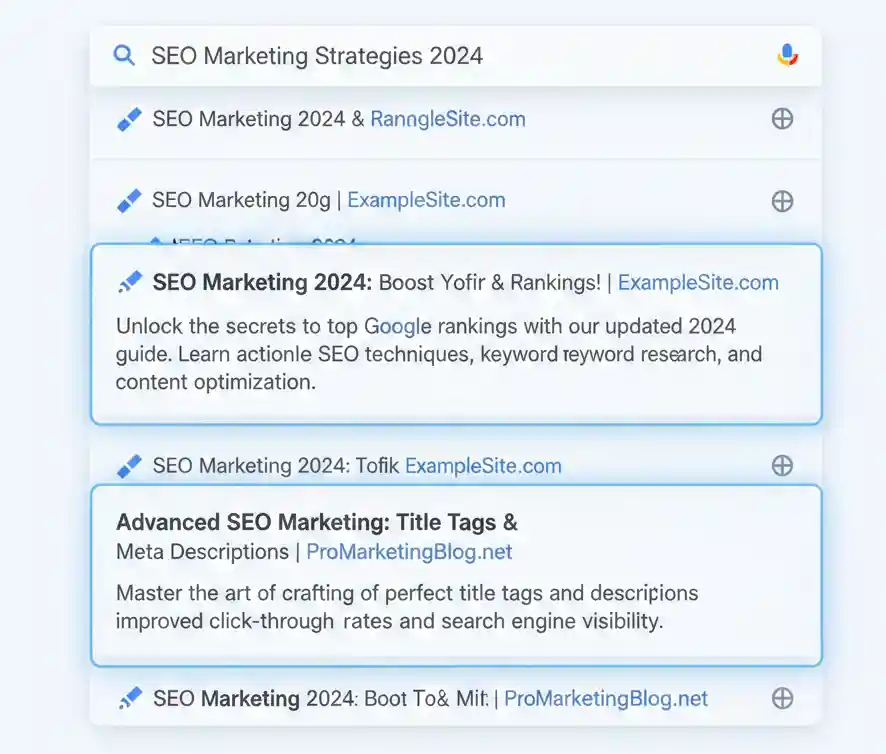
Optimizing title tags and meta descriptions is one of the fastest ways to improve click-through rate (CTR) without changing rankings. In SEO Marketing, these two elements act as your search ad copy. If they are weak, users scroll past—even if you rank well.
This guide breaks down how to optimize title tags and meta descriptions for higher CTR using proven SEO Marketing best practices.
Why Title Tags and Meta Descriptions Matter in SEO Marketing
In SEO Marketing, rankings get visibility—but CTR drives traffic. Title tags and meta descriptions influence whether users click your page or a competitor’s.
When optimized correctly:
- Search intent is matched clearly
- Emotional triggers increase engagement
- Users understand value instantly
As a result, Google may reward higher CTR with better long-term performance.
How to Optimize Title Tags for Higher CTR
1. Place the Focus Key Phrase Early
Search engines and users prioritize the beginning of a title tag. Therefore, your focus key phrase should appear naturally near the start.
Example:
Optimize Title Tags and Meta Descriptions for Higher CTR | SEO Marketing
2. Use Power Words That Drive Action
Words like proven, essential, effective, or complete increase curiosity. In SEO Marketing, emotional relevance often outperforms generic phrasing.
However, clarity must always come before creativity.
3. Stay Within the Ideal Length
Title tags should remain between 50–60 characters. Longer titles may be truncated, which reduces clarity and CTR.
To verify length, tools like Moz’s title preview are helpful:
Moz Title Tag Guide – https://moz.com/learn/seo/title-tag
4. Match Search Intent Precisely
If users search “how to optimize,” your title must clearly signal a guide or tutorial. Misaligned titles reduce trust and clicks.
How to Optimize Meta Descriptions for Higher CTR
1. Expand on the Title Tag Promise
Meta descriptions should support the title—not repeat it. In SEO Marketing, this space is used to sell the click.
Tip: Focus on benefits, not features.
2. Include the Focus Key Phrase Naturally
While meta descriptions are not a ranking factor, Google often bolds matching terms. This visual emphasis can increase CTR.
3. Add a Clear Call-to-Action
Strong CTAs guide user behavior. Examples include:
- Learn how
- Discover the strategy
- Read the full guide
Because of this, users feel encouraged to act.
4. Keep It Within Optimal Length
Aim for 140–160 characters on desktop. Shorter descriptions may lack context, while longer ones risk truncation.
Google Meta Description Best Practices:
https://developers.google.com/search/docs/appearance/snippet
Common SEO Marketing Mistakes to Avoid
- Keyword stuffing that hurts readability
- Duplicate title tags across multiple pages
- Auto-generated meta descriptions with no intent match
- Titles that lack emotional or practical value
Avoiding these issues helps improve CTR steadily over time.
Supporting SEO Marketing Resources
- Google Search Central – https://developers.google.com/search
- Ahrefs CTR Study – https://ahrefs.com/blog/organic-ctr/
- Backlinko SERP CTR Analysis – https://backlinko.com/google-ctr-stats
For internal guidance and advanced SEO Marketing strategies, explore:
https://creativeidealabs.com/


