

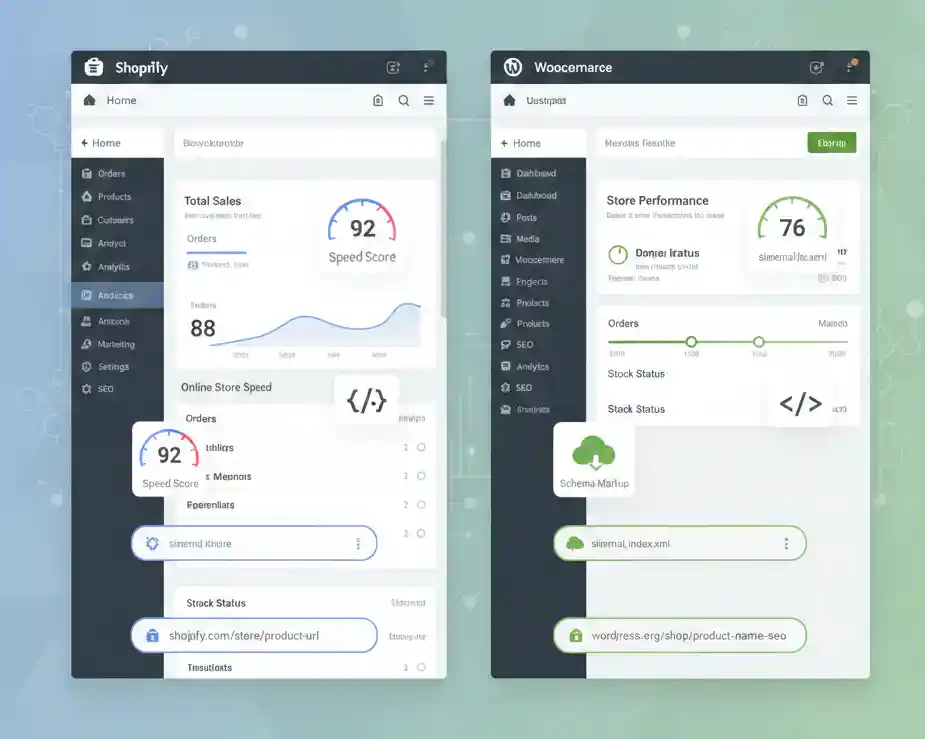
Choosing the right eCommerce platform affects your long-term SEO Marketing success. Both Shopify and WooCommerce offer powerful tools, yet they differ in flexibility, technical control, and scalability.
In this guide, we break down the key differences between Shopify and WooCommerce from an SEO perspective. As a result, you can make a confident decision that aligns with your growth goals.
Understanding SEO for Shopify vs WooCommerce
When comparing SEO for Shopify vs WooCommerce, the biggest difference lies in control. Shopify is a hosted platform, while WooCommerce runs on WordPress and offers full customization.
Therefore, your SEO Marketing strategy depends on how much technical flexibility you need.
1️⃣ Technical SEO Capabilities
Shopify: Controlled but Limited
Shopify manages hosting, security, and core performance. Consequently, it simplifies technical SEO tasks.
Advantages:
- Automatic sitemap generation
- SSL included
- Fast hosting infrastructure
- Mobile-optimized themes
Limitations:
- Fixed URL structures (/products/, /collections/)
- Limited control over robots.txt (improved but still structured)
- Restricted advanced customization
Although Shopify makes SEO easier for beginners, advanced users may find its structure restrictive.
Learn more from Shopify’s official SEO guide:
Shopify SEO Guide – https://www.shopify.com/blog/seo-guide
WooCommerce: Full SEO Control
WooCommerce runs on WordPress, which gives you complete access to technical SEO settings.
Advantages:
- Fully customizable URL structure
- Advanced schema control
- Robots.txt editing
- Wide plugin ecosystem
For example, plugins like Yoast SEO (https://yoast.com/) enhance metadata, readability, and schema management.
However, WooCommerce requires proper hosting and performance optimization. Without it, SEO Marketing results can suffer.
2️⃣ Page Speed & Performance
When evaluating SEO for Shopify vs WooCommerce, page speed plays a major role.
- Shopify provides optimized hosting by default.
- WooCommerce depends on your hosting provider, theme, and plugin stack.
If you invest in premium hosting and caching, WooCommerce can outperform Shopify. Otherwise, Shopify offers more consistent performance out of the box.
For performance benchmarks, refer to:
Google PageSpeed Insights – https://pagespeed.web.dev/
3️⃣ On-Page SEO Flexibility
Both platforms support:
- Title tags
- Meta descriptions
- Image ALT text
- Canonical tags
Nevertheless, WooCommerce provides deeper customization. You can implement advanced schema markup, dynamic content optimization, and programmatic SEO strategies.
If your business plans aggressive content marketing, WooCommerce integrates seamlessly with blogging strategies via WordPress.
Explore our internal guide on advanced strategies here:
👉 SEO Strategy Services – https://creativeidealabs.com/
4️⃣ Content Marketing Integration
Content drives SEO Marketing growth. Therefore, platform flexibility matters.
Shopify
- Basic blogging functionality
- Limited advanced content structuring
- Requires apps for expanded capabilities
WooCommerce
- Native WordPress blogging
- Category and tag optimization
- Full editorial control
For brands relying heavily on organic content, WooCommerce offers stronger SEO potential.
5️⃣ Scalability & Long-Term SEO Growth
Scalability affects your SEO Marketing ROI.
- Shopify scales easily with minimal technical involvement.
- WooCommerce scales with greater flexibility but requires technical oversight.
If you want convenience, Shopify wins.
If you want complete SEO authority, WooCommerce dominates.
Final Verdict: SEO for Shopify vs WooCommerce
The choice depends on your goals:
| Factor | Shopify | WooCommerce |
|---|---|---|
| Ease of SEO Setup | ✅ Very Easy | ⚠ Requires Setup |
| Technical Control | Limited | Full Control |
| Hosting Management | Included | Self-Managed |
| Advanced SEO | Moderate | Advanced |
| Content Marketing | Basic | Powerful |
Ultimately, SEO for Shopify vs WooCommerce comes down to simplicity versus control. Both platforms can rank well. However, WooCommerce provides stronger long-term SEO Marketing flexibility.


