

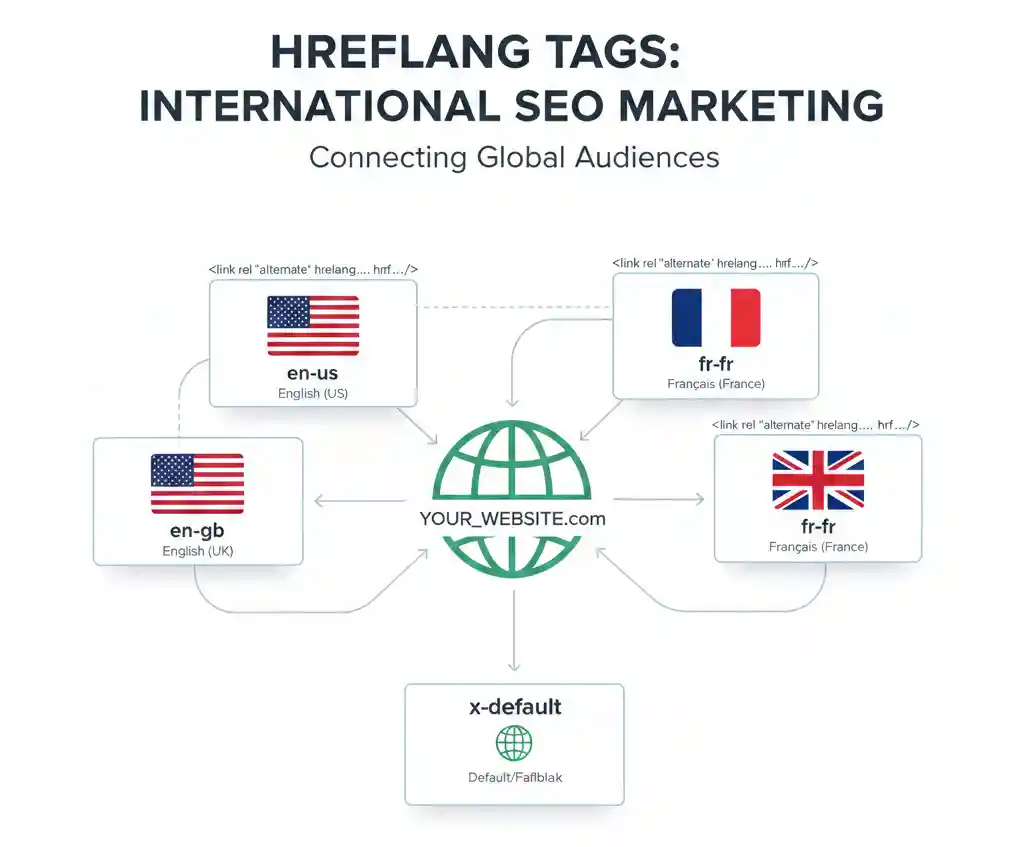
International websites live or die by relevance. If search engines show the wrong language or regional version of a page, users bounce—and rankings suffer. That’s exactly where hreflang tags step in as a critical tool in SEO Marketing.
This guide breaks down what hreflang tags are, why they matter, and how to implement them correctly—with clear examples you can actually use.
What Are Hreflang Tags in SEO Marketing?
Hreflang tags are HTML attributes that tell search engines which language and regional version of a webpage should be shown to users.
In SEO Marketing, hreflang tags help search engines:
- Serve the correct language version
- Target the correct country or region
- Avoid duplicate content issues
- Improve international user experience
They are especially important for businesses operating across multiple countries or languages.
Why Hreflang Tags Matter for International SEO Marketing
Without hreflang tags, search engines may:
- Rank the wrong language page
- Compete your own pages against each other
- Deliver poor localized search results
By contrast, properly implemented hreflang tags:
- Strengthen global SEO Marketing strategies
- Increase engagement and conversion rates
- Improve crawl efficiency for multilingual sites
According to Google’s international SEO guidelines, hreflang is the recommended method for managing language and regional targeting.
Source: https://developers.google.com/search/docs/specialty/international/localized-versions
Hreflang Tag Syntax Explained
Here’s the basic structure:
Key Components:
- rel=”alternate” – Indicates an alternative version
- hreflang=”en-us” – Language + country code
- href – URL of the matching page
This syntax is foundational to hreflang tags in SEO Marketing.
Where to Implement Hreflang Tags
In SEO Marketing, hreflang tags can be implemented in three places:
- HTML
<head>section - HTTP headers (for non-HTML files like PDFs)
- XML sitemaps (recommended for large websites)
Google confirms that sitemap-based hreflang is easier to manage at scale.
Source: https://www.sistrix.com/ask-sistrix/hreflang/
Common Hreflang Mistakes to Avoid
Even advanced SEO Marketing teams make these errors:
- Missing return links (non-reciprocal tags)
- Incorrect language or country codes
- Mixing canonical tags incorrectly
- Using hreflang on non-equivalent pages
Each page must reference itself and all its alternatives.
Best Practices for Hreflang Tags in SEO Marketing
- Always use ISO language and country codes
- Keep content intent identical across versions
- Test with Google Search Console
- Combine hreflang with strong internal linking
For scalable international SEO strategies, many agencies recommend pairing hreflang with structured sitemaps.
Internal SEO Marketing Insight
If your site serves multiple regions, hreflang should be part of a broader technical SEO framework. At Creative Idea Labs, international SEO Marketing strategies often integrate hreflang with content localization, site architecture, and performance optimization.
Learn more: https://creativeidealabs.com/
External Resources for Further Reading
- Google International SEO Guide
https://developers.google.com/search/docs/specialty/international - Moz Guide to Hreflang
https://moz.com/learn/seo/hreflang-tag


